
Discover why society equates a woman’s financial independence with family failure. Unpack the truth behind early-onset domestication and female social conditioning.
We look at an adult woman effortlessly managing a household, anticipating the needs of everyone in the room, and balancing intense emotional undercurrents, and we call it maternal instinct. We call it a natural talent.
But it isn’t an instinct. It is early-onset domestication.
The reality we choose to ignore is that from the moment a girl is born, she enters an invisible training camp driven by systemic female social conditioning. While boys are often encouraged to build, explore, take physical risks, and test their boundaries, girls are handed toy kitchen sets and baby dolls. They are taught to look after younger siblings, serve water and food to guests, and monitor the household if no one is home. They are heavily practiced in looking after the small things.
By the time a woman reaches adulthood, she has thousands of hours of uncredited, unpaid practice in caregiving and emotional labor. Society then labels this a natural instinct, using praise to disguise a rigorous, lifelong training structure designed to benefit everyone but her.
Also read: Healing from “Good Girl” Conditioning: From People-Pleasing to Sovereignty
This continuous gender roles conditioning doesn’t just teach a woman how to run a home—it subtly chips away at her internal sense of self-reliance. When you are trained from childhood to constantly be on the lookout for other people’s comfort, your brain undergoes a psychological shift:
Hyper-Vigilance as a Duty: You learn to read the room constantly, anticipating moods and shifting your behaviour to keep the peace.
The Approval Trap: You are taught to evaluate your worth based on how well you serve a collective structure (family, guests, partner) rather than what you are building for yourself.
The Safety Illusion: Because you are kept within the safety of domestic expectations, you are rarely taught the raw, real-world survival skills—like aggressive financial management, navigating high-stakes negotiations, or dealing with professional confrontation.
You don’t learn how to rely on yourself; you learn how to make yourself indispensable to everyone else at the cost of your own ambition.
This training camp doesn’t stay in one place. It follows women directly into their professional lives and businesses. If you look closely, the same domestic expectations are mirrored in the modern workplace:
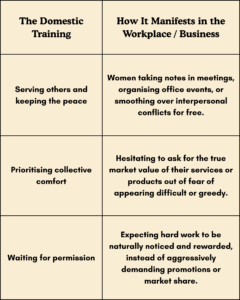
This systemic design is exactly why the narrative shifts the moment a woman breaks the script and achieves exceptional financial success. Suddenly, the very society that praised her compliance begins weaponising defensive labels against her:
She’s too difficult.
She can’t maintain a home.
She is incapable of managing a family or holding down a meaningful relationship.
Why does financial capability suddenly equal emotional failure in the eyes of society?
Because traditional structures rely heavily on a woman’s financial dependency to keep her compliant.
When a woman relies on a setup for her food, shelter, and status, she has to swallow her boundaries. She has to tolerate disrespect.
Money changes the math. Money equals choice.
When a woman achieves financial independence, the illusion of her incapability shatters. She no longer needs to tolerate inequality or toxic dynamics just for the sake of basic survival. She can no longer be managed or humbled by the threat of being left unprotected, because she is fully capable of protecting herself.
Let’s correct the narrative once and for all: a financially independent woman is entirely capable of being a deeply loving partner, a brilliant mother, and building a meaningful family. In fact, she often builds far healthier relationships because they are based on genuine choice rather than forced survival.
The only thing she is truly incapable of doing is sustaining a one-sided sacrifice. She will no longer clip her own wings to keep a fragile setup comfortable.
Stop calling women incapable of family just because they are fully capable of feeding themselves. True partnership doesn’t require a woman’s dependency; it requires her autonomy.
If you want to transition from passive survival to absolute autonomy, you must intentionally audit where your childhood conditioning is still running your adult life:
Are you still volunteering to carry the emotional weight of everyone around you at the expense of your time, energy, and business focus? Learn to say a clean, unapologetic no.
Making money is not a selfish act that ruins families; it is the ultimate tool for agency. Your financial success gives you the power to protect, choose, and live on your own terms.
Stop waiting for a traditional setup or a savior to build your security. Step out, learn the logistics of wealth, invest in your own skills, and become your own foundation.
If you are ready to unlearn the conditioning, step out of the dependent setups, and build absolute, undeniable self-reliance, you don’t have to navigate it alone.
Mindfulsome was built to be your ultimate resource hub for personal autonomy and raw growth. Explore our curated guides, deep-dive books, and upcoming frameworks designed to help you take 100% ownership of your trajectory. The tools are here. The choice is yours.
Leave your thoughts in the comments below: How has early-onset domestication shown up in your own life? Let’s talk.